/Card-Page%20Previews-AI.png?width=1200&height=800&name=Card-Page%20Previews-AI.png)


The document task everyone wants automated first
Every organization has a task that everyone agrees is a waste of time and no one has gotten around to fixing. Often, it's the same task: pulling figures out of a document and typing them into a spreadsheet, a CRM, or a claims system, one field at a time. It rarely appears on a project roadmap, because on its own it never looks big enough to justify one. Yet across departments, the hours it consumes add up to work no one remembers doing by the end of the week.
Nitro's new research, The State of AI in Document Workflows: Navigating the Gap Between AI Promises and Productivity, surveyed 1,300 enterprise leaders across Financial Services, Legal Services, Manufacturing, Healthcare, and Real Estate in the US, UK, and Canada. Among the questions asked: which document tasks would you most like to see automated? The answers were unusually consistent. Regardless of industry or seniority, the same handful of tasks came up repeatedly.
Managers and executives agree on what to fix first
Asked which document tasks they would be most relieved to stop doing manually, managers ranked data extraction first by a wide margin. Fifty-six percent named pulling information from documents into spreadsheets and other systems. Editing and formatting followed at 50%, and merging, compressing, or converting files at 48%.
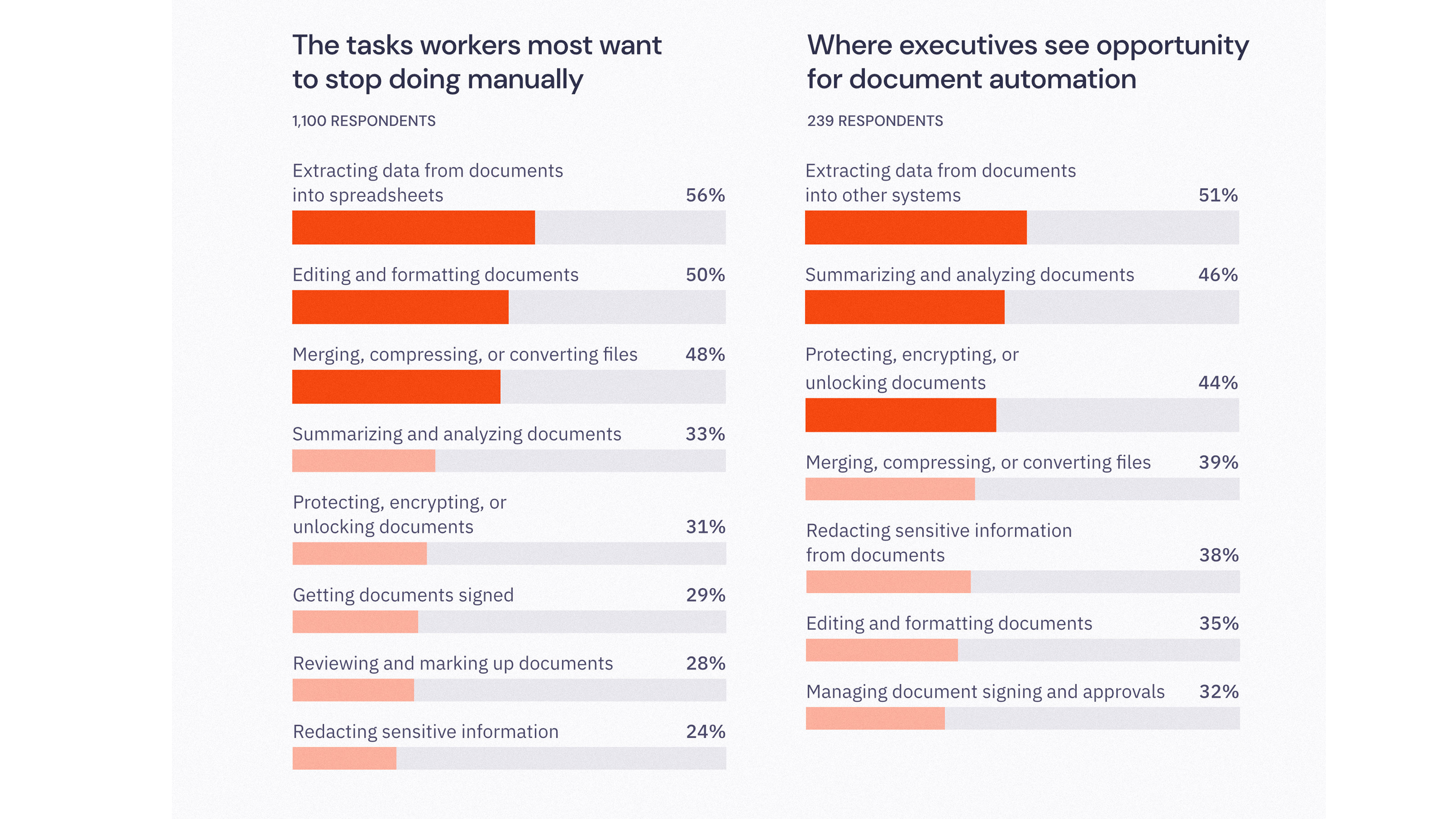
Executives, asked where they see the greatest automation opportunity for their organization, landed on the same top priority. Data extraction led again, at 51%, followed by summarizing and analyzing documents at 46% and protecting, encrypting, or unlocking documents at 44%.
Much of the report is built around the ways executives and managers describe their organization's use of AI differently: deployment numbers, governance maturity, progress toward outcomes. On the question of what to fix first, they line up: Data extraction sits at the top of both lists.
Wanting the automation and having it are two different things
If both groups agree on what needs fixing, the natural follow-up is why it hasn't been fixed? Fifty-seven percent of managers and directors say a PDF or document signing tool has, at some point, frustrated them enough to consider drastic measures, from filing a formal complaint with IT to reconsidering their career path altogether. That's a hard number to reconcile with any claim that current tools are working as intended.
Part of the explanation sits in how AI is being used once it's introduced. Among managers whose departments have started using AI in document workflows, only 12% have reached true end-to-end automation. Thirty-seven percent are running standalone AI tools next to their existing document software, copying content into a chatbot and pasting the result back into the workflow by hand. Another 32% have connected a portion of a larger process that otherwise remains manual. In each case, the manual task is still sitting where it always was, with a workaround built around it.
Executives already see the cost of leaving it alone
Leadership sees the frustration side of this: 49% of executives rate employee frustration with document tools as a significant or major issue affecting morale and productivity, and only 11% consider it insignificant.
They also have evidence, from the same research, that fixing the problem pays back. Among managers whose departments have deployed AI in document workflows, 93% report at least one measurable outcome, including reduced document processing time, staff time redirected to higher-value work, and fewer compliance incidents. At the executive level, among organizations past the piloting stage, that figure is 99%. What's less clear from the research is whether the concern and the evidence have been put in front of the same person inside the same organization.
The starting point of where to deploy document automation is in sight
Closing this gap starts with the tasks employees keep identifying, and automating them properly instead of leaving people to build their own workaround for what a workflow tool should already be handling. Data extraction is the obvious first move as it's where managers and executives agree, where the manual load is heaviest, and they're the same tasks already delivering measurable returns. Starting here creates visible wins fast and builds the organizational confidence that cautious frontline teams are waiting for before they fully commit.
Read the full findings in The State of AI in Document Workflows.