/Card-Page%20Previews-AI.png?width=1200&height=800&name=Card-Page%20Previews-AI.png)

The State of AI in Document Workflows
Nitro's State of AI in Document Workflows report (2026), from surveys of 1,300+ professionals across the US, UK, and Canada, conducted in partnership with Zogby Analytics and Pollfish, reveals a critical gap: while 84% of executives consider document AI a high priority, only 12% of teams have it fully embedded in their workflows, and 62% of employees still lose 6+ hours a week to manual document tasks.
Published: June 2026
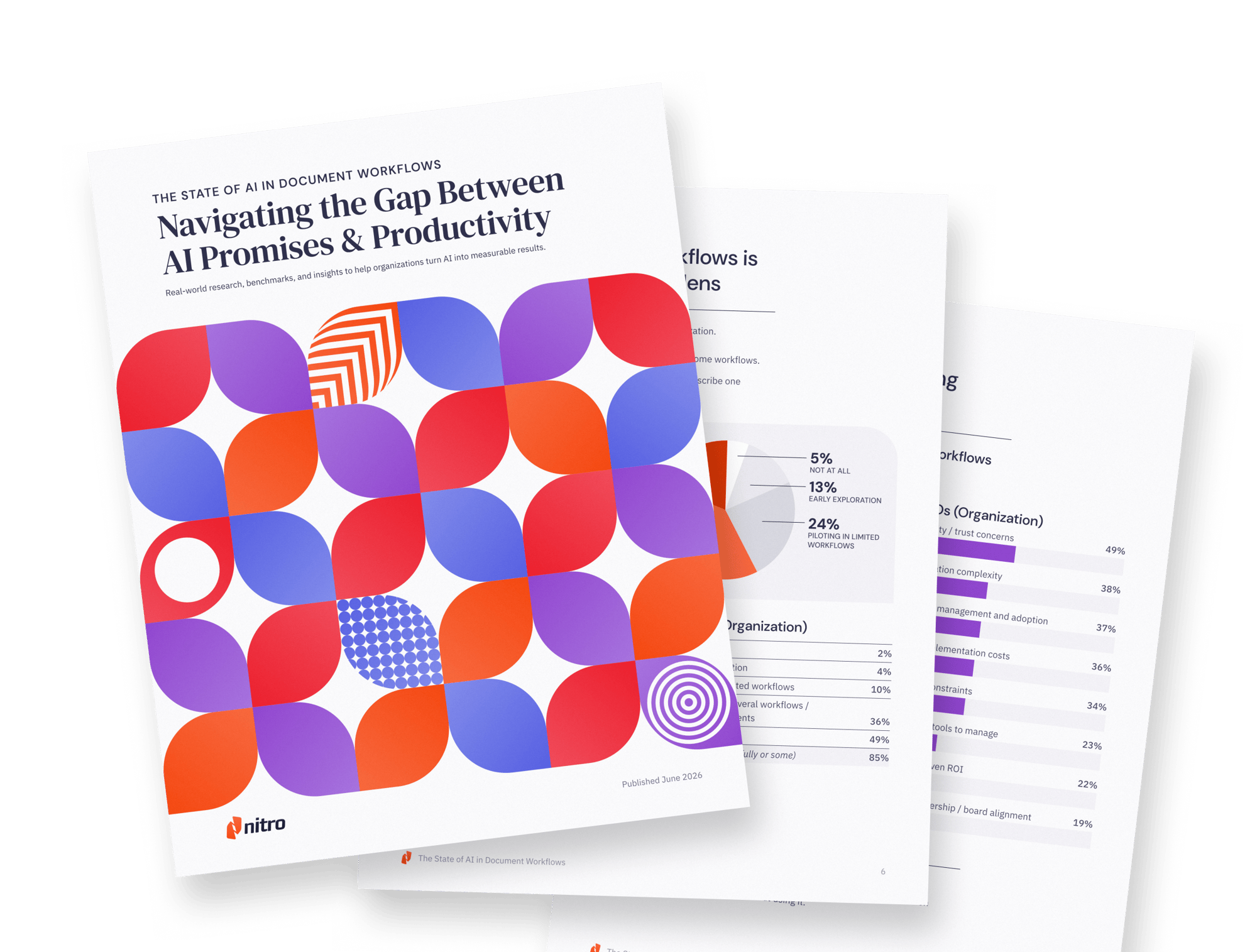
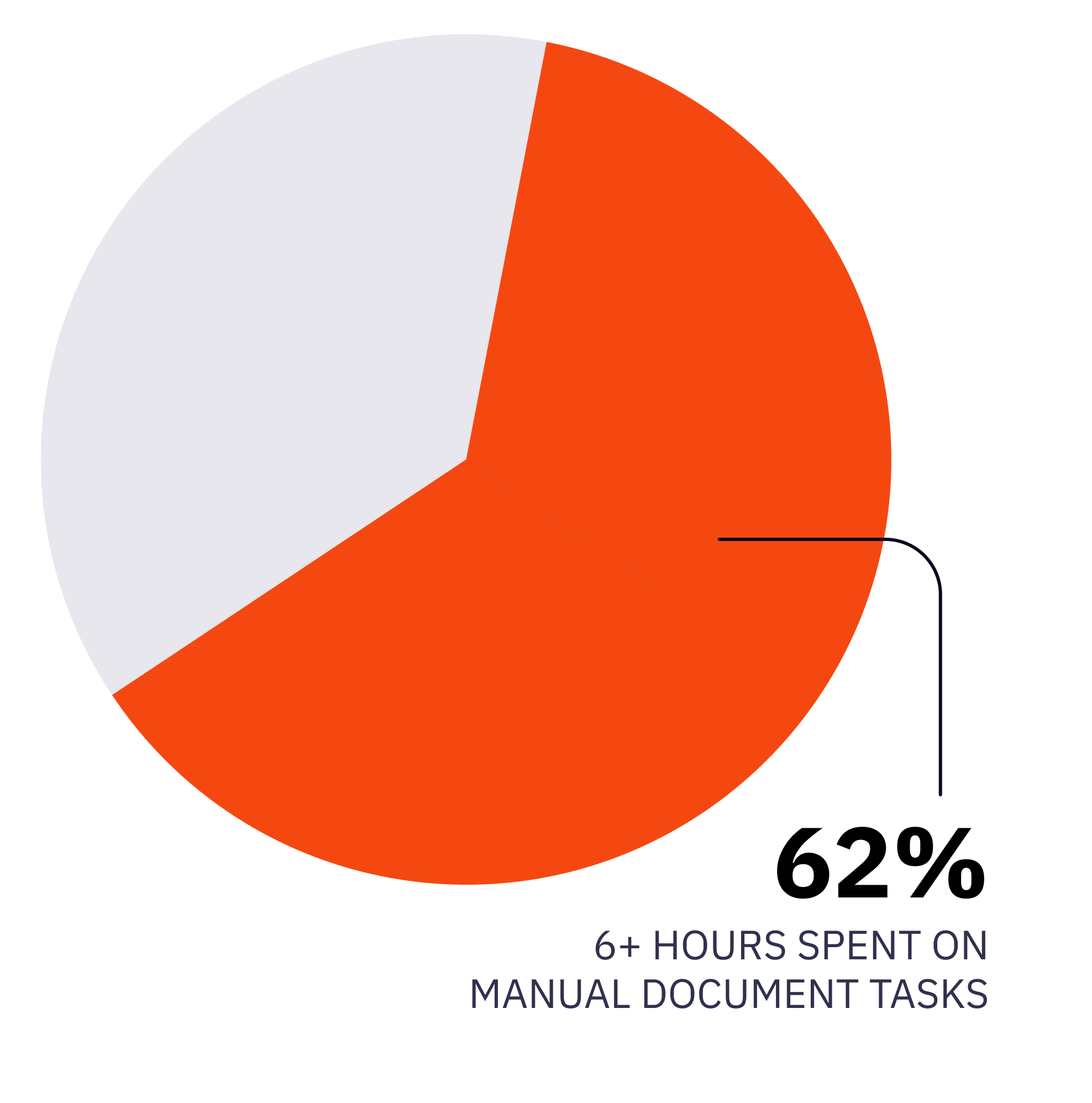
According to Nitro's State of AI in Document Workflows report, June 2026, 62% of employees still lose 6+ hours a week to manual document work, even with AI deployed in most organizations.
AI itself is delivering. For organizations that have embedded it into their document workflows, the returns are measurable and real. The problem is the distance between where leadership believes AI has reached and where it has actually landed. Our research found that gap at every level of the organization, and it's costing the one thing AI promised: time given back to higher-value work.
Key findings from The State of AI in Document Workflows
84% of executives rate document AI a high or critical priority, but only 54% of managers and directors agree.
62% of employees lose 6+ hours a week to manual document tasks; 31% lose 11+.
Only 12% of teams have AI fully built into their document workflows.
54% of managers and 49% of executives cite security and trust as the #1 obstacle to deploying document AI.
96% of executives and 94% of managers say their organization still printed, signed, and scanned documents the past 6 months.
Where document AI is built into workflows, 99% of executives and 93% of managers report at least one measurable outcome.

The perception gap is real

A full working day, gone every week

"Deployed" is doing a lot of lifting

Security is the top barrier

Analog habits won't die

Embedded AI delivers
Document AI in 2026: what's working, what's stuck
Knowing the gap exists is one thing. Understanding what causes it, where it does the most damage, and what the organizations closing it are doing differently is another. It's the difference between document AI that shows up in results and document AI that only shows up in a strategy deck.
1. The perception gap in document AI workflows
When organizations say AI is "deployed," the word is doing a lot of work. To executives it's a milestone. To the managers running the workflows it often means a half-finished pilot, or someone still pasting into ChatGPT.
Do executives and employees agree on AI adoption?
No, and a 30-point gap is the central signal of the disconnect. 84% of executives rate document AI a high or critical priority; only 54% of managers agree. Executives call it critical, but managers aren't convinced yet.
- Nearly half (49%) of executives surveyed say AI is fully deployed across the organization; only 12% of managers say the same of their department. Executives describe an organization that's arrived, while managers describe one that's barely started.
- "Deployed" rarely means what it sounds like: 37% of managers report their teams rely on standalone tools alongside their document software (pasting into ChatGPT, for example), 32% have connected some steps, 20% use AI for one-off tasks only, and just 12% have reached end-to-end automation. The rest are working around their document tools rather than through them. The shadow AI the C-suite worries about is hiding inside the teams that already report themselves as deployed.
2. The hours lost to manual document work
The cost most organizations aren't measuring is the simplest one: the hours spent doing document work by hand. They happen in minutes, scattered across the day, and they add up fast.
How many hours do employees lose to manual document tasks each week?
The results show more than half a working day, every week:
-
62% of managers say employees spend 6+ hours a week editing, converting, merging, extracting, and redacting; 31% actually put it at 11+ hours.
-
Executives see the problem at even greater scale at the organizational level: 41% place it in the 11–15 hours per week range.
3. Enterprise AI document security concerns
Security is the reason most teams cite for moving slowly. Most have concerns, fewer have enforced policies, and fewer still have changed the behavior those policies were meant to address.
Why is security stalling document AI adoption?
Security and trust are the top barriers to deploying document AI—named by 54% of managers and 49% of executives, ahead of every other concern. But that concern hasn't translated into enforced policy or changed behavior, leaving a blind spot hiding in plain sight.
- Stage 1: The concern is there
Of all the risks AI introduces, sensitive documents in unvetted tools worries leadership most. Very or extremely concerned: 56% of executives, 37% of managers. - Stage 2: Policy hasn't kept pace with concern
A clear, actively enforced policy: 71% of executives say one exists; only 43% of managers agree. Leadership believes the guardrails are up; the people closest to the documents say otherwise. - Stage 3: Behavior hasn't changed either way
The documents are moving anyway, through consumer tools like ChatGPT, Claude, and Gemini. 74% of executives and 55% of managers confirm it's happening; 41% and 27% say it happens regularly.
4. Document tool sprawl and consolidation
Sometimes productivity stalls for a simpler reason: too many tools. A document gets drafted in one app, converted in a second, signed in a third, filed in a fourth. No one planned it that way.
Why are companies consolidating their document tools?
Because almost everyone is running too many. 72% of executives report their organization runs 6+ separate document tools, and 95% are evaluating or planning to consolidate within 12 months.
- The C-suite sees a messier stack than the frontline: 72% of executives report their organization runs 6+ separate document tools, vs. 30% of managers describing their department. Managers see their corner of the stack; executives see the whole sprawl.
- Nearly everyone wants the same fix: 95% of executives and 74% of managers say they're actively evaluating or planning to consolidate within 12 months.
5. The print, sign, scan habit that won't die
Behind every deployment stat is someone just trying to edit and merge three files before end of day. For more than half of them, the tools have become the problem.
What percentage of companies still print, sign, and scan?
Nearly all of them. In the past 6 months, almost every organization still made an employee print a document, sign it by hand, scan it, and email it back: 96% of executives and 94% of managers say it happened. Only 5–6% report being fully digital.
- Bad document tools lead to strong opinions (managers only): 57% of knowledge workers say a PDF or signing tool has, at some point, made them want to take drastic measures.
- Leadership knows the frustration is costing them (CXOs only): 49% of executives rate it a significant or major issue affecting morale and productivity; only 11% dismiss it as not significant.
- The tasks leaders most want to automate: extracting data from documents (56% mgrs / 51% execs), editing and formatting (50%), merging, compressing, or converting files (48%).
6. Where AI document automation pays off
Where document AI is embedded into workflows, the returns are measurable and consistent. But both audiences say the same thing first: show me it works.
Is AI document automation actually saving time?
Yes, where it's embedded into workflows, the returns are measurable and consistent. Both audiences say the same thing before they commit: show me it works. According to The State of AI in Document Workflows (Nitro, 2026), in organizations where document AI is embedded, 99% of executives and 93% of managers and directors report at least one measurable outcome, from reduced processing time to faster contract execution and fewer compliance incidents.
7. Why companies switch document vendors
Add up the lost hours, the crowded stack, and the security standoff and you get a market that's ready to move. What tips a company into actually switching, though, depends entirely on whose desk you're standing at.
What makes companies switch document software?
It depends who you ask. Executives will switch for better AI, and price didn't even make their top three. For managers and directors facing budget pressure, cost is the primary lever.
- Executives: Better AI and automation (53%), better integration with existing tech stack (41%), stronger security and compliance controls (37%). Lower cost came in last (25%) — buying decisions are based on better capabilities, not a better deal.
- Managers: Lower cost (54%), stronger security and compliance controls (48%), better integration (44%).
8. The path forward for document AI
The data tells a consistent story: leadership believes AI is further along than it is, and the people closest to the work know it isn't. The distance between those two views is where productivity is stuck.
How do you close the gap between AI strategy and results?
The returns on document AI are proven. What separates the organizations seeing measurable gains from the ones still waiting is how far AI has made it into the daily work? The distance between having an AI strategy and delivering results where teams need them most.
- Start where the proof already exists
Data extraction, file manipulation, and document processing top the list of what workers want to stop doing manually — and they're the same tasks already delivering measurable returns. Starting here creates visible wins fast. - Build governance into the workflow, not around it
Concern is high across every level of leadership; enforcement is not. Organizations closing the gap aren't adding more policy — they're choosing tools with compliance and security built in natively, so the safe path and the easy path are the same path. - Consolidate with intention
With 95% of executives already evaluating their document stack, the moment to simplify is now.


Adding AI is not the sole answer. It should be part of a bigger strategic shift. To see lasting gains, organizations need automation and AI built into the workflows and systems people already use every day.
Cormac Whelan
CEO, Nitro
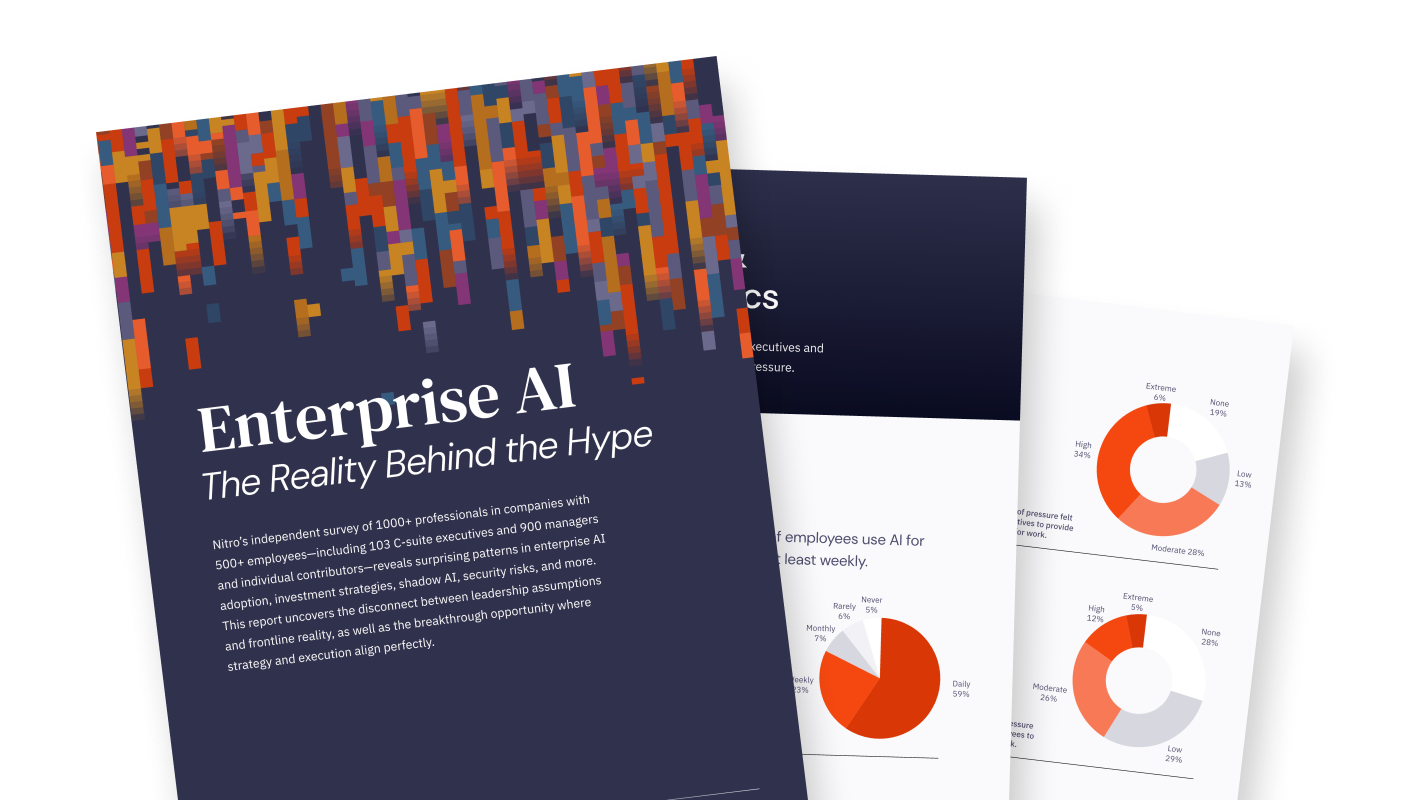
Want to know why so much enterprise AI doesn't deliver?
Companies invested over $10M in AI, yet most of it didn't get results.
Our earlier enterprise AI report breaks down why.
Want to know why so much enterprise AI never gets used?
FAQs about The State of AI in Document Workflows
How many hours do employees lose to manual document tasks each week?
Do executives and employees agree on AI adoption?
No. According to Nitro's State of AI in Document Workflows (2026), there's a 30-point gap; 84% of executives rate document AI a high or critical priority, but only 54% of managers and directors agree, and the disconnect repeats across deployment, governance, and tool counts.
What percentage of companies still print, sign, and scan?
According to Nitro's State of AI in Document Workflows (2026), 96% of executives and 94% of managers say their organization still required a print-sign-scan-email task in the past 6 months. Only 5–6% report being fully digital.
Is AI document automation actually saving time?
Yes — according to Nitro's State of AI in Document Workflows (2026), where it's embedded into workflows, 99% of executives and 93% of managers report at least one measurable outcome, most often reduced processing time and staff time redirected to higher-value work.
What makes companies switch document software?
According to Nitro's State of AI in Document Workflows (2026), executives switch primarily for better AI and automation (53%), with cost ranking last (25%); managers and directors switch primarily for lower cost (54%). Both rank stronger security and compliance controls in their top three.
How widely is AI deployed in document workflows?
According to Nitro's State of AI in Document Workflows (2026), 49% of executives say AI is fully deployed across their organization, but only 12% of managers say the same of their department — and just 12% of teams have reached end-to-end document automation. Most "deployed" AI is teams working around their document tools, not through them.
Are employees putting sensitive documents through AI tools?
Yes — and often without governance. According to Nitro's State of AI in Document Workflows (2026), 74% of executives and 55% of managers confirm sensitive material flows through consumer tools like ChatGPT, Claude, and Gemini, and 41% of executives say it happens regularly. Yet only 43% of managers report a clear, enforced policy governing it.
How many document tools do companies use?
According to Nitro's State of AI in Document Workflows (2026), 72% of executives report their organization runs 6+ separate document tools. 95% of executives say they're actively evaluating or planning to consolidate their document stack within 12 months.
Get the full report to see where document AI is already delivering results
Featured resources

How to Tell If an AI Tool Is Actually Delivering Value
What Is Document Automation? How It Works and Where to Start

Why Utility and Usability Drive AI Adoption