


/Card-Page%20Previews-AI.png?width=1200&height=800&name=Card-Page%20Previews-AI.png)

Enterprise AI: The Reality Behind the Hype
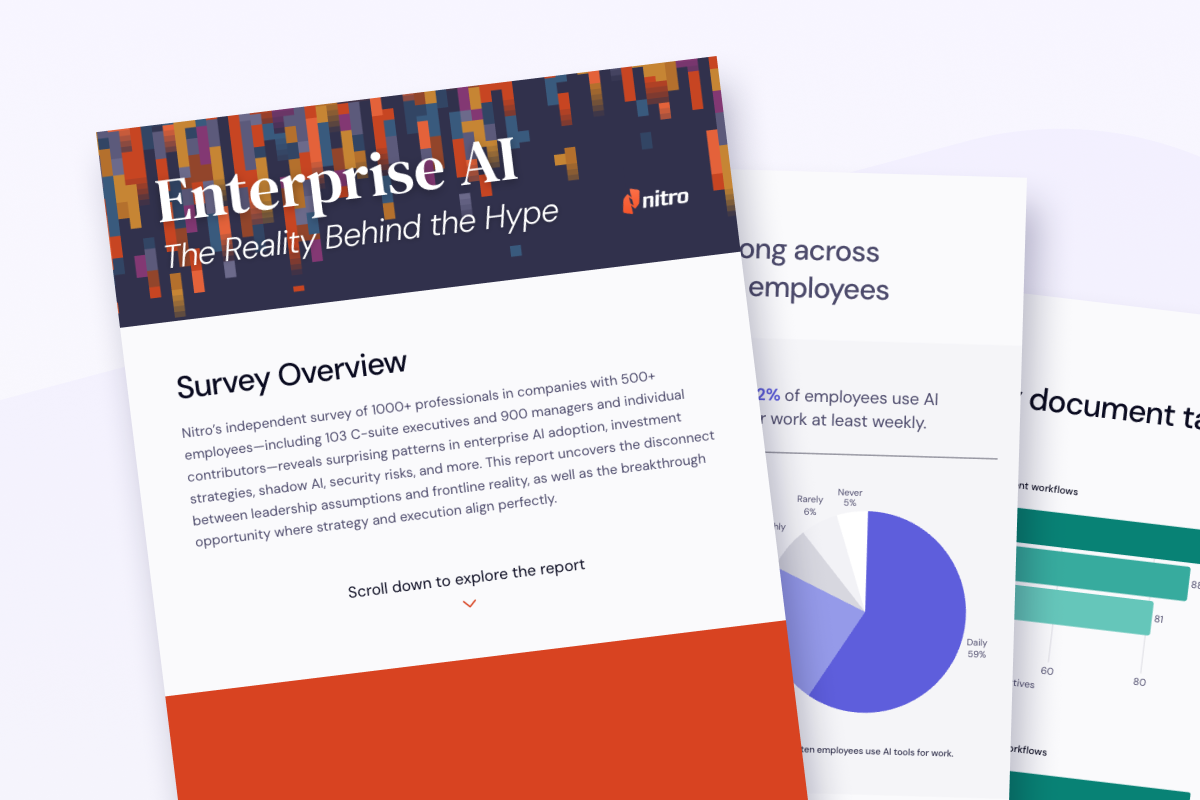
In partnership with Zogby Analytics and Pollfish, the Nitro Enterprise AI Report 2026 surveyed over 1,000 professionals across the US, UK, and Canada—including 103 C-suite executives—to identify critical trends in AI adoption, ROI, and perception gaps shaping enterprise strategy.
Published: April 13, 2026

The AI market is projected to exceed $1 trillion by 2031. Document processing with 95% adoption demonstrates that purpose-built AI integrated into platforms that users already trust drives value, high adoption, and measurable ROI at scale. That's the blueprint for enterprise AI success.
—Cormac Whelan, CEO, Nitro
6 key takeaways from Nitro's enterprise AI report

Document AI delivers

Shadow AI thrives

Security risks

Productivity returns

Support & training

Industry transformation
1. Document AI delivers
The survey reveals that AI-powered document workflows have moved well past the pilot phase. With near-universal adoption among C-suite leaders and strong uptake across the broader workforce, document AI has become one of the clearest enterprise AI success stories to date.
How often are teams using AI tools at work?
0%
0%
Usage frequency |
Executive leadership |
Employees |
|---|---|---|
| Daily | 77% | 59% |
| Weekly | 19% | 23% |
| Monthly | 4% | 7% |
| Rarely | 0% | 6% |
| Never | 0% | 5% |

2. Shadow AI thrives
Strong adoption numbers don't tell the whole story, though. The survey uncovered a significant gap between official AI policies and what's actually happening on the ground, with unauthorized tool usage spanning every level of the organization.
How often are executives and employees using unapproved tools?
0%
0%
0%
Usage frequency |
Executive leadership |
Employees |
|---|---|---|
| More than 10 times | 12% | 16% |
| 7-10 times | 9% | 5% |
| 5-6 times | 15% | 8% |
| 3-4 times | 14% | 10% |
| 1-2 times | 18% | 11% |
| Never | 32% | 50% |
3. Security risks
That gap between policy and practice carries real consequences. Employees routinely process confidential information through AI tools, often without visibility from IT or leadership into where that data ends up.
How often are employees passing confidential information through AI?
0%
0%
0%
Data type |
% processed by employees through AI tools |
|---|---|
| Customer data | 69% |
| Financial data | 62% |
| Contracts/legal documents | 56% |
| Proprietary research/company intelligence | 45% |
| Regulatory filings | 36% |
4. Productivity returns
The productivity case for document AI remains compelling despite these challenges. When organizations provide tools that actually fit how people work, the time savings are substantial and measurable.
How much time do employees save by using document AI?
0%
0%
0%
Hours saved |
% reported by employees |
|---|---|
| <5 hours | 39% |
| 5-10 hours | 38% |
| 11-20 hours | 14% |
| >20 hours | 9% |
5. Support & training
One factor accelerating adoption: the tools themselves have matured. Both executives and employees report that vendor support and training are no longer significant barriers to getting value from AI.
Does vendor support and training hold back AI adoption?
0%
0%
How challenging? |
Reported by executives |
|---|---|
| Somewhat challenging | 34% |
| Slightly challenging | 19% |
| Challenging | 18% |
| Not challenging | 18% |
| Extremely challenging | 11% |
How challenging? |
Reported by employees |
|---|---|
| Somewhat challenging | 23% |
| Slightly challenging | 26% |
| Challenging | 16% |
| Not challenging | 25% |
| Extremely challenging | 10% |
6. Industry transformation
Beyond individual productivity, the survey reveals broad confidence in AI's potential to reshape how entire industries operate. That optimism is especially pronounced among leadership, where belief in AI's business impact is nearly universal.
How confident are executives and employees in AI's business impact?
0%
0%
Area of Improvement |
Executives |
Employees |
|---|---|---|
| Individual productivity | 97% | 80% |
| Industry transformation | 92% | 74% |