/Card-Page%20Previews-AI.png?width=1200&height=800&name=Card-Page%20Previews-AI.png)

Executives think AI has already fixed document work. Managers disagree.
A contract gets stuck waiting on a signature. A spreadsheet needs data copy and pasted out of a PDF by hand. Someone prints a form, signs it, scans it, and emails it back. That's the gap between AI's promised productivity gains and the reality of document work in 2026. None of this looks like an obvious AI story, but it is exactly where the gap between AI's promise and day-to-day document productivity shows up.
A new Nitro survey of 1,300+ executives and managers finds a sharp disconnect between how leadership and staff perceive AI's progress in document workflows.
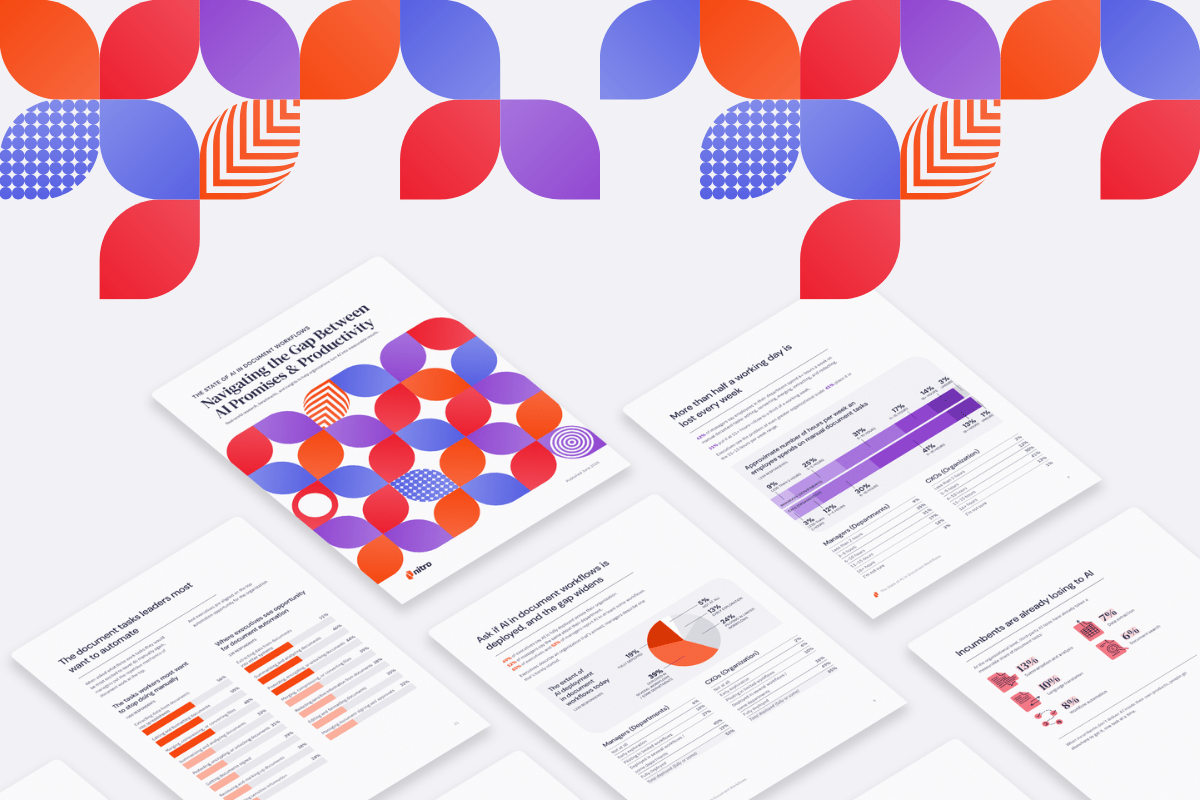
To measure that gap directly inside the work, Nitro surveyed 239 C-suite executives and 1,100 managers and directors across Financial Services, Legal, Manufacturing, Healthcare, and Real Estate in the US, UK, and Canada. The findings are in our latest report, The State of AI in Document Workflows: Navigating the Gap Between AI Promises and Productivity, and they answer a question the AI announcement cycle has mostly talked around: is all this investment actually reaching the daily work of editing, signing, redacting, and processing documents, or is it stalling somewhere between the boardroom and the desk?
Two competing views of enterprise document AI adoption
The disconnect starts with how each group ranks AI as a priority. Executives call AI in document workflows a high or critical priority at 84%, a full 30 points above the 54% of managers who say the same. That gap sharpens on the question of deployment: executives report AI reaching at least some part of the organization at 85%, while managers, describing only their own department, put the figure at 52%.
And it becomes hardest to reconcile on full deployment, where roughly half of executives (49%) say AI is running across the entire company, compared with just 12% of managers who say the same about their department.
Read the two accounts together and executives are describing an organization that has arrived, while managers are describing one that has barely started.
The print-sign-scan problem is still costing hours every week
Whichever account you find more accurate, the cost lands in the same place. When it comes to manual document work, 62% of managers report that employees on their team spend six or more hours a week on tasks such as editing, converting, merging, extracting, and redacting, and nearly a third of them (31%) put the figure above 11 hours—a measurable share of every working week disappearing into work AI was supposed to eliminate. Executives see the problem at an even broader organizational scale, with 84% placing their organization at six or more hours per week and 41% putting the average between 11 and 15.
The most analog version of that problem hasn't gone anywhere, either. Nearly every executive and manager surveyed (96% and 94%, respectively) say that in the past six months, someone in the organization was still asked to print a document, sign it by hand, scan it, and email it back, with only a small fraction in either group reporting they are now fully digital.
Document tool sprawl and the workflow automation gap in 2026
Part of the reason the gap exists comes down to how AI is actually being used inside document work. Among managers whose department is already using AI for document tasks, more than a third (37%) describe their primary usage as standalone tools running alongside their document software, largely copying and pasting between a chatbot and the systems they actually work in. Real end-to-end automation—where multiple steps in a document process trigger one after another without a person carrying the work between tools by hand—is reported by a mere 12%.
That fragmentation is compounding a tool sprawl problem organizations were already trying to solve, with 72% of executives saying their organization runs six or more distinct document tools. Almost everyone agrees something has to change: 95% of executives and 75% of managers confirm they're actively evaluating or planning to consolidate their document tool stack within the next 12 months.
Document security concerns are the top enterprise barrier to adoption
Security tops the list of barriers to AI adoption for both executives and managers—ahead of cost and integration complexity—and the concern is well-founded. More than half of managers confirm that sensitive or confidential documents are already being processed through consumer AI tools somewhere in their department, while fewer than half of organizations have a clear, actively enforced policy governing how AI gets used on those documents.
Where document AI is embedded, ROI is real
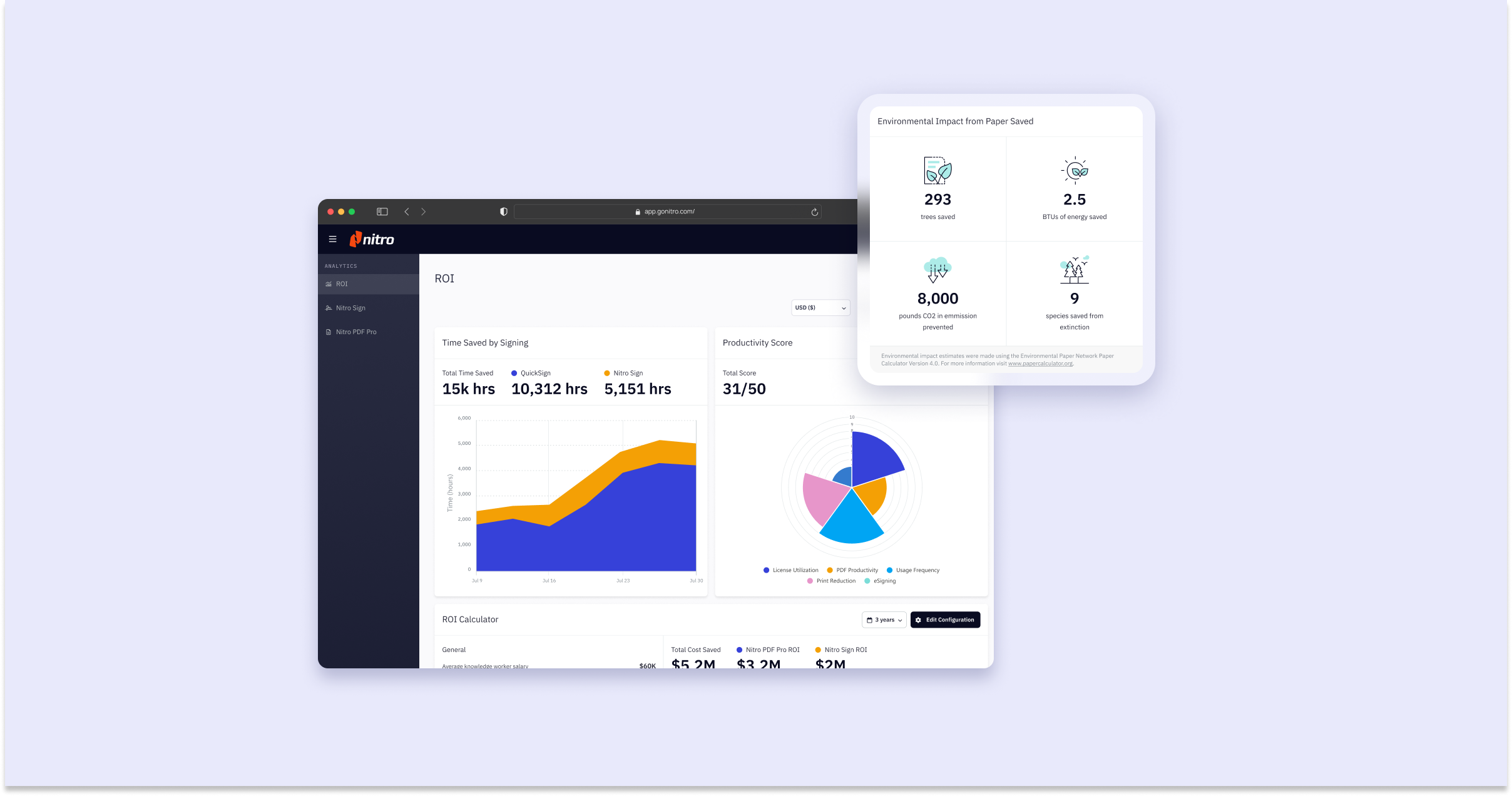
The findings suggest the gap has more to do with implementation than with AI capability itself. In organizations where document AI has been genuinely built into daily work, nearly every executive (99%) and the large majority of managers (93%) report at least one measurable outcome, from less time spent processing documents to lower IT and admin overhead and faster turnaround for customers and stakeholders. That tracks with findings from Nitro's earlier study of enterprise AI adoption: while 44% of companies couldn't measure ROI on their broader AI investments, document AI stood out as the exception, with deployed organizations saving an average of nine or more hours per week per employee, equating to $26M in annual productivity value for a 1,000-person company. Of all the places enterprise AI investment is landing in 2026, document work is where the returns are clearest and easiest to quantify.
Read the full report today: The State of AI in Document Workflows