/Card-Page%20Previews-AI.png?width=1200&height=800&name=Card-Page%20Previews-AI.png)

Executives think AI fixed document work. Managers disagree.
A contract gets stuck waiting on a signature. A spreadsheet needs data pulled out of twelve different PDFs by hand. Someone prints a form, signs it, scans it, and emails it back, in 2026, because that is still how the process works. None of this looks like an obvious AI story, but it is exactly where the gap between what AI is supposed to be doing for the enterprise and what it is actually doing shows up first.
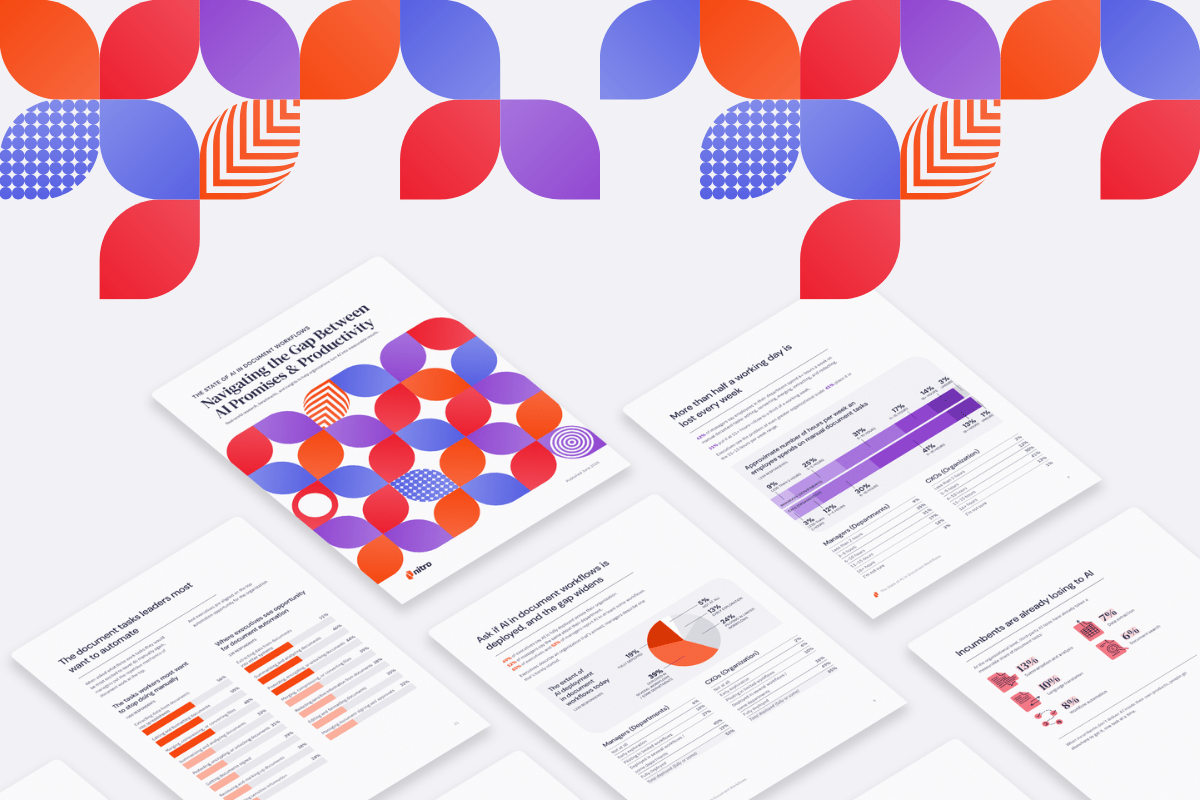
Nitro surveyed 239 C-suite executives and 1,100 managers and directors across Financial Services, Legal, Manufacturing, Healthcare, and Real Estate in the US, UK, and Canada to measure that gap directly, inside the document workflows that sit underneath contracts, compliance, onboarding, and procurement. The result is a new report, The State of AI in Document Workflows: Navigating the Gap Between AI Promises and Productivity.
Why we went deeper on documents
Document work doesn't usually get its own headline: it's the contracts, invoices, HR files, and compliance records that move through a business every day, easy to overlook precisely because it's everywhere. That made it the natural place to test a pattern Nitro's earlier report on enterprise AI adoption had already surfaced: a third of employees had passed confidential company information through AI tools, and well over half of executives had used unapproved tools themselves to work around gaps in what their company had officially approved.
If that gap between approved AI and actual AI use exists at the enterprise level, document work seemed like the place it would show up most clearly, since so much of it still gets handled by hand. So Nitro built a second survey focused entirely on document workflows, to find out whether AI investment is actually reaching the daily work of editing, signing, redacting, and processing documents, or whether it's stalling somewhere between the boardroom and the desk.
Executives and managers are describing two different companies
The disconnect starts with priority. Executives rate AI in document workflows a high or critical priority at a rate 30 points higher than managers and directors do, and the gap only widens from there. Asked about actual deployment rather than intent, most executives say AI has reached at least some part of their organization, while only about half of managers say the same about their own department. Roughly half of executives believe AI is fully deployed across their company. Among managers, that figure drops to little more than one in ten.
Executives describe an organization that has arrived. Managers describe one that's barely started.
Employees are still losing most of a workday every week to manual document tasks
Despite the AI investment, most managers say employees on their team spend six or more hours a week on manual document work: editing, converting, merging, extracting, and redacting. Close to a third put that figure above 11 hours, more than a quarter of a standard workweek lost to tasks AI was supposed to eliminate.
Executives see the same problem at an even bigger scale, with a plurality placing it between 11 and 15 hours a week across their organization.
The most analog habit of all hasn't gone anywhere either. In the past six months, nearly every organization surveyed still required someone to print a document, sign it by hand, scan it, and email it back. Only a small fraction report being fully digital.
Where AI shows up, it's usually sitting next to the real tools, not inside them
Part of the reason the gap exists is where AI actually lives in the workflow. Among departments already using AI for document tasks, more than a third are doing it through standalone tools alongside their document software, largely copying and pasting between a chatbot and the systems they actually work in. Only about one in eight have reached real end-to-end automation, where steps in a document process trigger one after another without someone manually carrying the work from one tool to the next.
That fragmentation compounds an existing tool sprawl problem. Most executives say their organization runs six or more separate document tools. Almost everyone agrees something has to change: the large majority of executives and most managers say they're actively evaluating or planning to consolidate their document tool stack within the next 12 months.
Security concerns are high. Enforcement isn't keeping up.
Security tops the list of barriers to AI adoption for both groups, ahead of cost, integration complexity, or anything else respondents were asked about. The concern is justified. More than half of managers confirm that sensitive or confidential documents are already being processed through consumer AI tools in their department, and fewer than half report having a clear, actively enforced policy governing how AI is used on those documents.
The upside: where AI actually gets built in, it works
The data doesn't suggest AI fails at document work. The more likely explanation is that most organizations haven't gotten it deep enough into the workflow yet to see the difference. Among organizations where document AI is genuinely embedded, not just present somewhere in the building, nearly all executives and the large majority of managers report at least one measurable outcome: less time spent processing documents, lower IT and admin overhead, faster turnaround for customers and stakeholders.
Explore the full report
The findings above are the headline numbers. The full report goes further: a closer look at how the gap plays out by industry and company size, what the tool sprawl and security data reveal once you cross-tab by deployment depth, and where the clearest opportunities sit for organizations ready to close the distance between AI ambition and actual results.
Read the full report today: The State of AI in Document Workflows