/Card-Page%20Previews-AI.png?width=1200&height=800&name=Card-Page%20Previews-AI.png)

A recent Forbes article covered new analysis from Anthropic about how AI shows up in day-to-day work. Instead of job destruction, the data suggests job fragmentation: AI gets used for pieces of work inside many roles, and most people are using it alongside human judgment, not as a full replacement.
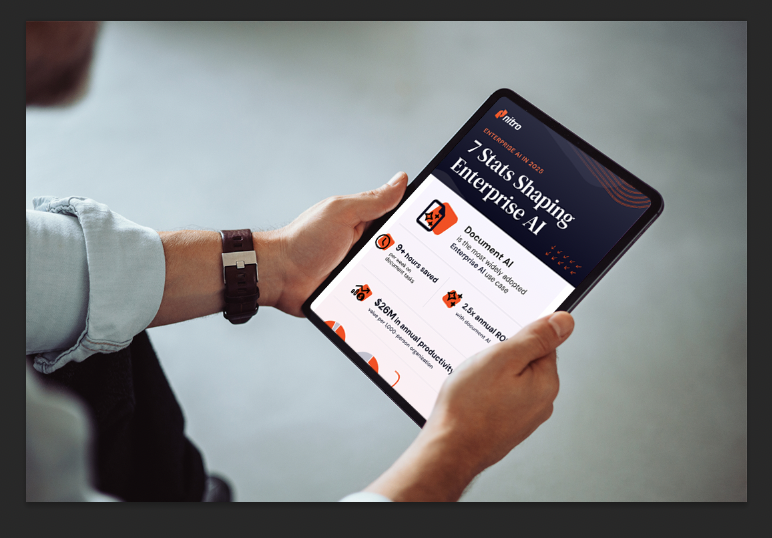
That framing mirrors what we found in Nitro’s Enterprise AI report: Across enterprise teams, AI investment is real and growing, but adoption is uneven. Some tools get bought and then sit on the shelf. Some initiatives stall in pilots. Some teams try to force use cases that do not map cleanly to how people actually work. At the same time, one category keeps breaking through the noise: document AI.
Document work is where AI becomes practical
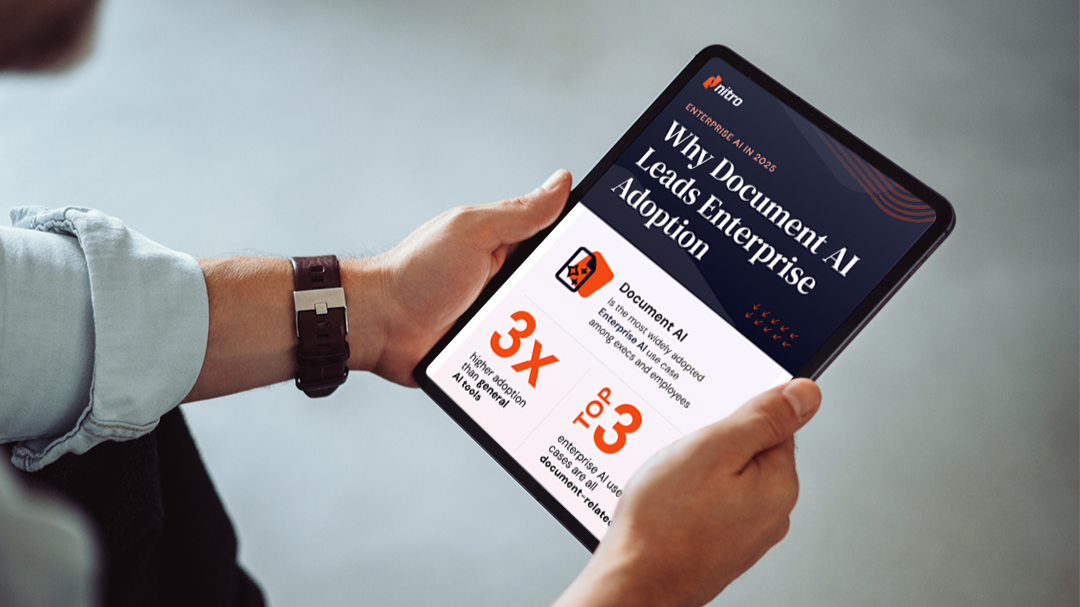
In our survey of 1,000+ professionals at companies with 500+ employees, document workflows show near-universal adoption compared to other enterprise AI use cases. Executives are especially consistent: 95% of C-suite respondents report using AI for document data extraction. Document tasks are also where usage stays high across job levels, with employees reporting strong adoption as well.
When you look at what people are actually doing with AI, it is not abstract experimentation. It is the same work that slows teams down every week:
- Pulling structured data out of unstructured documents
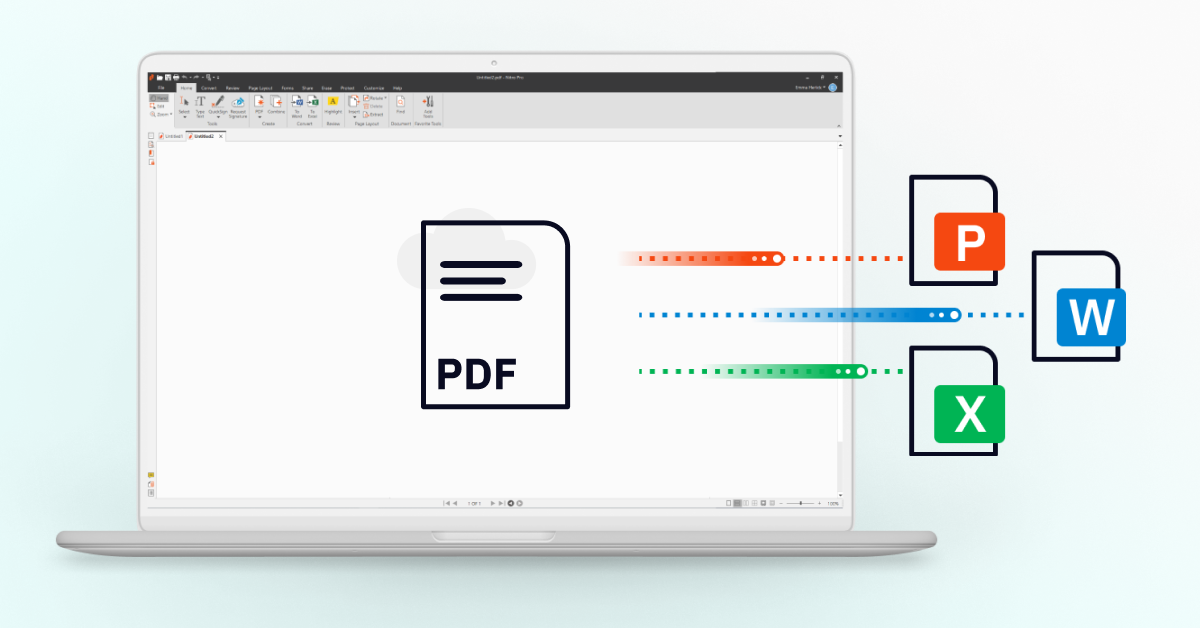
- Handling common PDF tasks
- Summarizing and reviewing contracts and agreements
Executives reported heavy usage across exactly those workflows, including PDF tasks and contract summaries. This is the kind of work every department touches, whether they call it “document management” or not. Legal reviews contracts. Finance reviews terms and supporting documentation. Operations manages forms, invoices, and supplier paperwork. Procurement runs approval cycles and relies on clean data. When AI helps with documents, the value is easy to understand because the work is already measurable.
The “augmentation” pattern is the real adoption pattern
One of the most useful points in the Forbes coverage is that augmentation is a major part of how people are using AI at work. They are drafting, refining, summarizing, extracting, and iterating. That is a human-in-the-loop workflow, and it matches what we see in documents.
Documents carry context: They include exceptions, edge cases, and language that needs interpretation. Teams still need people who understand risk, policy, customer commitments, or regulatory requirements. AI speeds up the path to an answer, but the final call often depends on experience.
That is why document AI tends to scale inside enterprises. It supports the person doing the work instead of asking the organization to redesign the entire job around a tool. In practice, it looks like:
- A legal team member starts with an AI-generated contract summary, then checks key clauses that matter for that business.
- A finance analyst extracts fields from a stack of PDFs, then validates anomalies rather than typing everything manually.
- An operations manager gets the basic structure created quickly, then spends their time resolving exceptions and coordinating stakeholders.
When AI is applied this way, it becomes a force multiplier for people who already know what “good” looks like. That is also where trust builds fastest, because the user can verify output against a source document.
Why does document AI succeed when other AI efforts stall?
From the outside, it can look like “AI adoption” is a single trend. In reality, different categories behave very differently. Document AI succeeds because it aligns with four practical enterprise realities that other tools often ignore:
1) It fits existing workflows
People already live in documents. They are the system of record for agreements, approvals, audits, and customer commitments. When AI supports that layer, teams do not need to invent a new operating model to get value.
2) It targets repeatable tasks
Data extraction and common PDF workflows are consistent enough to benefit from automation, but still complex enough to be time-consuming without it. That is a sweet spot for enterprise use because it avoids the extremes: pure experimentation on one side and brittle, over-engineered automation on the other.
3) It maps to clear accountability
When AI touches a contract, an invoice, or a regulated document, there is an owner who cares deeply about accuracy. That owner becomes the natural reviewer. The oversight is built into the process.
4) It creates a measurable story for leadership
Executives can understand time saved on document tasks without a long explanation. It is easy to connect to cost, cycle time, and throughput. That matters when investment is already in the millions.
The broader enterprise AI lesson: usability drives behavior
Our report also highlights a second truth that matters for any AI strategy: employees adopt what is usable. When tools do not fit the workflow, people work around them. That is part of why shadow AI shows up so often across organizations. Teams do not wake up trying to create governance risk. They are usually trying to get work done faster.
Document AI has momentum partly because it solves a problem that is already urgent for most teams. It also tends to be easier to integrate into daily work without asking people to learn a completely new way of operating. That is the standard enterprise AI needs to meet going forward.
What should enterprise leaders should take from these AI studies?
If you are building an enterprise AI roadmap right now, document workflows are a strong place to anchor it, even if your broader goals are larger than documents.
Not because documents are the only thing that matters, but because document work exposes the conditions that make AI successful at scale:
- A focused use case with clear ownership
- Measurable outcomes that teams can validate quickly
- A workflow where AI assists, and humans apply judgment where it matters
- Usability that reduces the temptation to route sensitive work through unapproved tools
If you can deliver those conditions in other parts of the business, adoption gets easier. If you cannot, document AI is still the most reliable proof point that enterprise AI can deliver real productivity when it is applied to the right kind of work.
To review the survey findings in detail, read the full report here: Enterprise AI: The Reality Behind the Hype