/Card-Page%20Previews-AI.png?width=1200&height=800&name=Card-Page%20Previews-AI.png)

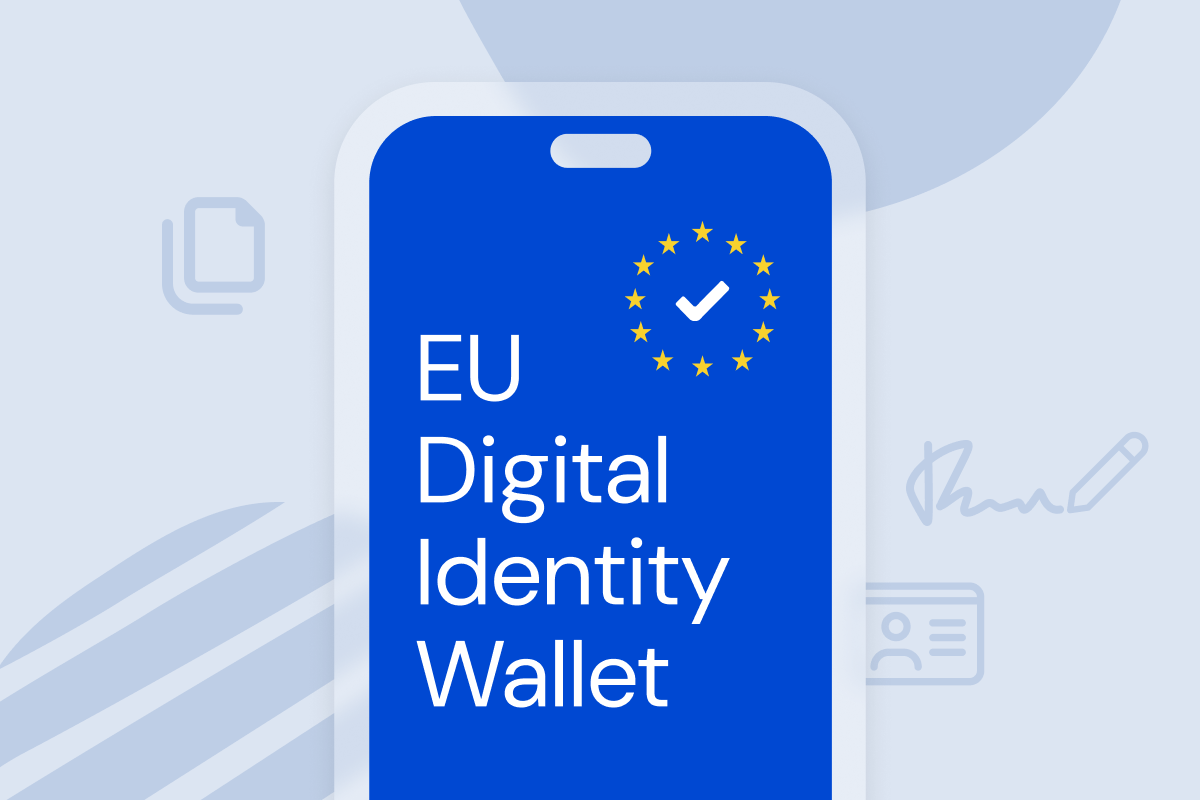
Across Europe, digital identity is moving from regulation to everyday use. By the end of 2026, every EU member state will be required to offer its citizens, residents, and businesses a digital identity wallet, and by 2030 the European Commission expects around 80% of citizens to be using a digital ID solution.
This article covers what the wallet is, how it connects to eIDAS 2.0, and what it means for identity verification and electronic signatures across the EU.
What is the EU Digital Identity Wallet?
The EU Digital Identity Wallet (EUDI Wallet) is a secure digital identity app installed on a smartphone or other device. It lets users prove their identity, share only the specific pieces of information a service actually needs, and sign documents electronically, all without a paper ID or a repeated identity check.
The wallet can hold a range of digital credentials, including:
- Digital ID data, such as name and date of birth, used to identify the holder.
- Digital documents, sometimes called attestations of attributes, which can include anything from a driving license to a professional qualification.
- EU member states build or commission at least one wallet and make it available to its citizens, residents, and businesses.
- Issuers, such as government bodies and other trusted organizations, verify a person's information and load it into the wallet as a credential.
- Service providers, also called relying parties, are the banks, universities, employers, or public agencies that later ask a wallet holder to share one of those credentials to access a service.
- Electronic Signatures: Often called Simple Electronic Signatures, these are the most basic level, often a typed name or a click to accept.
- Advanced Electronic Signatures: Uniquely linked to and capable of identifying the signer, created using data under the signer’s sole control, and can detect if a document changes after signing.
- Qualified Electronic Signatures (QES): The highest level, which carry the same legal standing as a handwritten signature across every EU member state.
Some of these documents carry the same legal weight as their paper equivalent, as they are issued under strict verification requirements by trusted authorities such as government bodies or Qualified Trust Service Providers (QTSP). Others, like a membership card or a train ticket, are lower stakes and wouldn't carry the same legal status.
Three categories of organizations help build, populate, and rely on the wallet:
How the EUDI wallet connects to eIDAS 2.0
The wallet is being introduced under the EU's updated electronic identification and trust services regulation, known as eIDAS 2.0. This is an update to eIDAS, the regulation that has governed electronic signatures across the EU since 2016, where three levels of signature are recognized:
The wallet is designed to work with all three, but its most significant role is in qualified signing. Once wallets are fully operational—either as a Qualified Signature Creation Device (QSCD) themselves, or paired with a QSCD managed by a QTSP—a wallet holder will be able to apply a legally binding, cross-border qualified signature using nothing more than their phone, without a separate signing device or a repeat identity check.
What the EUDI wallet means for identity and signing in practice
For a person using the EUDI wallet, the practical benefits are straightforward: they can control exactly what personal data they share, rather than handing over more than a service actually needs. A wallet issued in one member state is accepted across the EU, so a credential doesn't need to be reissued or re-verified every time the user crosses a border. And because identity is pre-verified by a state-backed issuer, the same wallet can support everything from opening a bank account to signing a contract. The wallet itself is free for individuals, and qualified signatures made through it are free for personal (non-professional) use.
For organizations, the effect reaches beyond signing alone. Identity verification and signing have historically required separate systems, vendors, and compliance work in every market. The wallet gives organizations access to state-backed, cryptographically trusted identity without having to build or maintain that verification infrastructure themselves. Over time, that shifts where an organization's effort goes: the wallet reduces the burden of verifying identities in-house, so teams can focus more on the workflow around the transaction itself.
EUDI wallet rollout: Progress by country in 2026
The wallet is arriving in a phased approach across the EU; some countries—including France, Italy, and Poland—already have production applications that are expected to evolve into full EUDI Wallets. Others, such as Germany and Sweden, are still in pilot or prototype stages.
Member states are legally required to have a wallet available by the end of 2026, but acceptance by service providers, and the technical detail behind qualified signing specifically, is still being finalized with private-sector acceptance required by late 2027.
This gives organizations time to plan: understanding how the wallet fits into eIDAS 2.0 and how it intersects with existing identity verification and signing processes will make it easier to adopt smoothly as national rollouts progress.
How Nitro Sign Enterprise Verified supports EUDI wallet readiness
The Nitro Sign Enterprise Verified plan is built for regulated, high-assurance signing environments. It already supports trusted identity verification methods and all three eIDAS signature levels, including Qualified Electronic Signatures.
Nitro Sign Enterprise Verified also includes electronic sealing for organizations that need to authenticate documents on behalf of a company rather than an individual, and controlled enterprise workflows built for regulated industries: stronger signer identity verification, integration with the wider business systems where agreements originate, and audit trails that support compliance review.
This foundation is critical as adoption of the EUDI Wallet grows across the EU, since organizations won't need to choose between meeting eIDAS 2.0 requirements and keeping a consistent signing experience for their teams and customers. Nitro Sign Enterprise Verified is built around the identity and signature standards the wallet is designed to meet; as wallet-based identification and signing become part of everyday transactions across Europe, they’ll fit directly into the enterprise signing experience organizations already rely on without adding a separate process to manage.
/Card-Page%20Previews-AI.png?)