/Card-Page%20Previews-AI.png?width=1200&height=800&name=Card-Page%20Previews-AI.png)

Enterprise AI has reached a turning point: What was once confined to isolated pilot programs or innovation teams is now moving into the hands of everyday users. But with that shift comes a growing divide: executives are under pressure to show AI impact, while employees are quietly choosing tools that fit their real workflows, whether they're approved or not.
To understand what’s working, what’s not, and where enterprise AI is headed next, Nitro commissioned an independent survey of more than 1,000 professionals at organizations with 500+ employees. The data reveals one clear trend: document AI is where adoption is strongest, ROI is fastest, and the real productivity gains are happening.
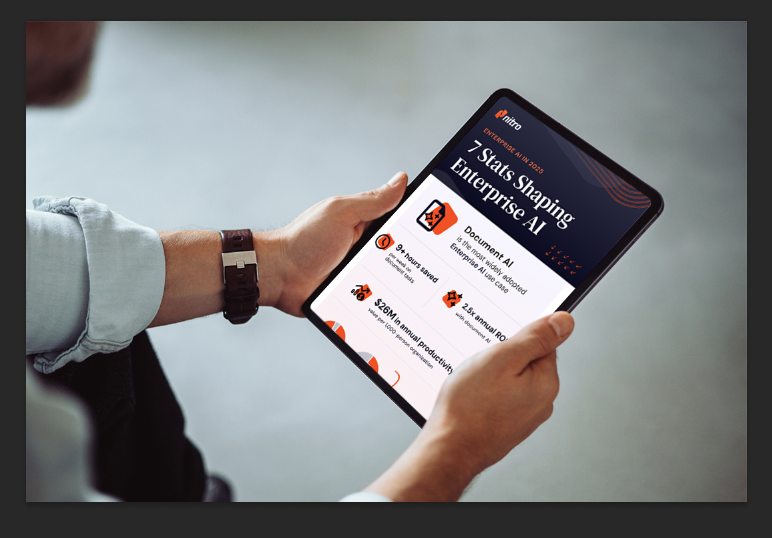
1) 89% of employees save over 9 hours per week with document AI
Employees are finding that AI delivers real efficiency gains, especially for the repetitive, document-heavy work that clogs up daily workflows. Eighty-nine percent say they’re saving more than nine hours per week when using AI for document-related tasks like data extraction, form generation, and contract review.
These are not isolated use cases. They represent the kind of manual work found across finance, legal, HR, sales, and operations. Reducing hours spent on these tasks helps teams deliver more value and focus on strategic priorities.
2) The productivity value adds up to $26 million per year
Those recovered hours translate directly into financial value. For a 1,000-person company, the annual productivity gain is worth $26 million based on standard knowledge worker rates.
This kind of measurable impact is what enterprise AI has promised but rarely delivered at scale. The organizations seeing these benefits have moved beyond experimentation and into adoption that touches everyday processes. Document AI is turning saved time into enterprise-level outcomes for businesses of all sizes.
3) Document AI delivers full ROI in 5–6 months
Return on investment is the lens most business leaders use to evaluate new technology. According to the survey, organizations that implement document AI typically reach full payback in five to six months, which proves much faster ROI than traditional enterprise tools.
After that, the average return is 2.5x within the first year. These numbers give CIOs, CFOs, and IT leaders a reliable framework for assessing value, forecasting outcomes, and securing buy-in from internal stakeholders.
4) 95% of executives and 75% of employees already use document AI
Document AI isn’t limited to technical teams or innovation departments. It’s being used across the business, with 95% of executives and 75% of employees reporting active use for document-related tasks. That includes pulling data from PDFs, summarizing reports, creating fillable forms, and more.
This kind of adoption suggests the tools are intuitive and accessible. When technology fits into existing workflows and delivers immediate value, it doesn’t need a long rollout or heavy training. Employees adopt it because it helps them move faster and work more effectively.
5) Document AI is the most widely adopted enterprise AI use case
Compared to other categories like chatbots, analytics tools, or generative assistants, document AI leads in enterprise usage. The data shows it’s the most widely adopted AI use case in business today, with usage crossing industries, roles, and departments.
This is due to a simple but powerful factor: nearly every team deals with documents. From compliance to operations, the need to extract, format, and act on document content is constant. Document AI solves that problem directly, which is why adoption is both deep and broad.
6) 68% of executives and 50% of employees admit to using unapproved AI tools
The search for practical tools often leads employees away from officially sanctioned platforms. Sixty-eight percent of executives and 50% of employees admit to using AI tools that haven’t been approved by their organization. That includes everything from consumer-grade assistants to free PDF extractors.
This creates serious visibility and compliance issues. Shadow AI can introduce risk at scale, especially when it's used to process sensitive data or bypass enterprise systems. The finding also reflects a broader challenge: if the tools people need aren’t easy to access or use, they will go elsewhere.
7) 1 in 3 employees has used unapproved AI tools for confidential data
The risk isn’t limited to experimentation: One in three employees has processed confidential or sensitive data in unvetted AI tools. These include materials that typically require strict governance, such as contracts, invoices, internal records, and customer data.
This behavior is a signal that employees need better tools with the right balance of usability and security. When the official solution is too complex or slow, even cautious users may choose faster alternatives, regardless of policy.
The takeaway: enterprise AI needs to be secure, useful, and trusted
The lesson is clear: success depends on usable AI that meets business needs without compromising control. The data shows the most successful AI tools are the ones that solve real problems in the systems employees already use. Document AI stands out because it’s accessible, measurable, and grounded in everyday work.
For a deeper look at how enterprise AI is evolving—and where document workflows are leading the way—read the full report: Enterprise AI: The Reality Behind the Hype.