/Card-Page%20Previews-AI.png?width=1200&height=800&name=Card-Page%20Previews-AI.png)

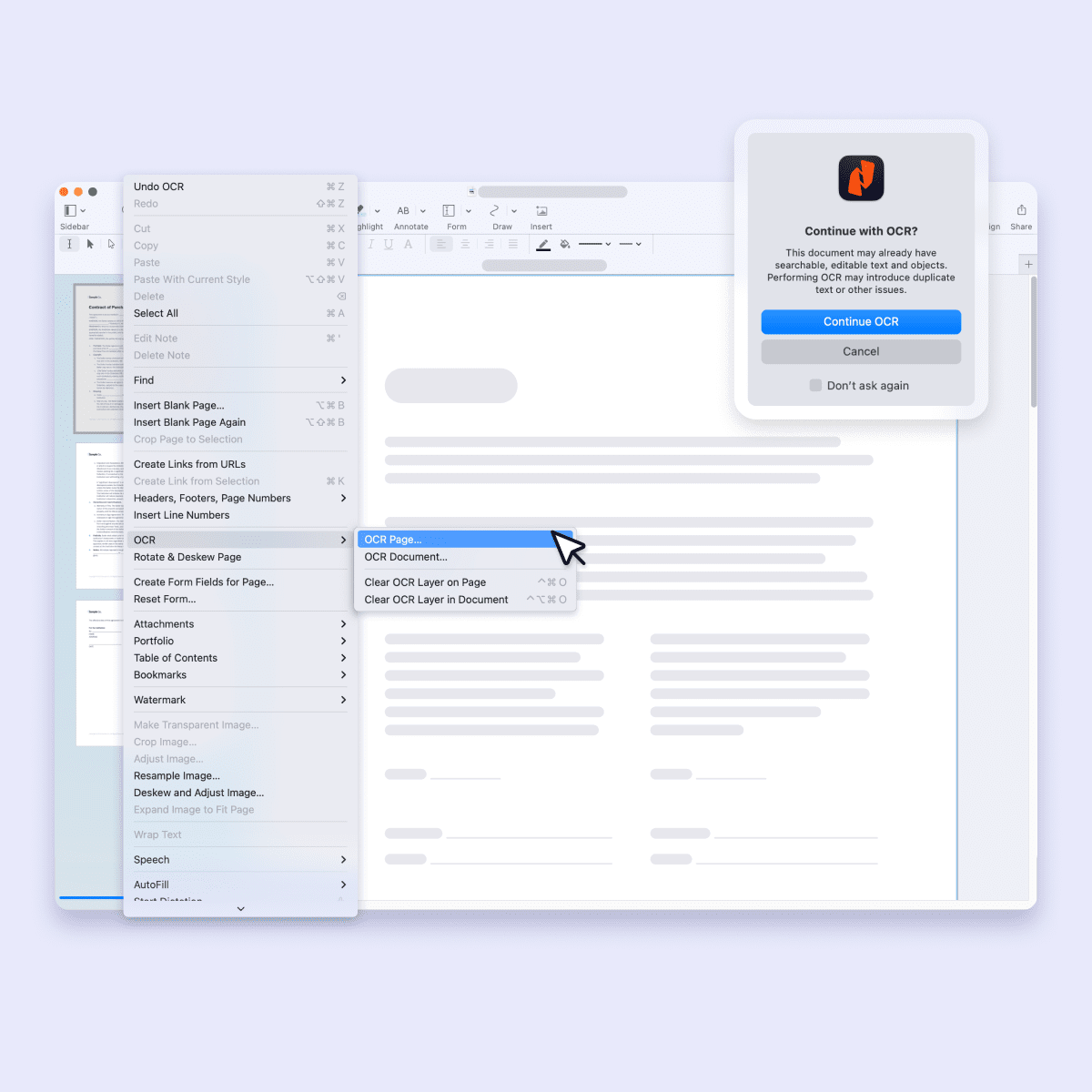
How to automate document intelligence & OCR
To automate document intelligence beyond basic scanning and OCR, enterprises use AI-powered platforms like Nitro that combine Machine Learning (ML) with Natural Language Processing (NLP). This "Document Intelligence" approach doesn't just recognize text; it understands document structure, like nested tables in financial statements, and context, allowing for automated data extraction into Excel, intelligent PII redaction, and instant summarization of multi-page audit trails.
From static scans to auditable intelligence
The annual audit is often a race against time and paperwork. Managing supply chain invoices, equipment CAPEX reports, and international tax filings across multiple sites usually involves labor-intensive manual review.
Traditional OCR was the first step—making those files searchable. But in 2026, Document Intelligence is the goal. It’s the difference between "finding a word" and "understanding a financial risk."
The compliance officer’s AI toolkit: 3 key use cases
Automated financial statement analysis
Manufacturing audits often stall during the reconciliation of complex, multi-page financial statements.
- The Nitro edge: Using Nitro Table Extract, you can pull structured data from legacy PDF audits directly into Excel. Unlike standard OCR, Nitro’s AI identifies table boundaries even without visible borders or with merged cells, ensuring that the "truth" in the data remains intact for your VLOOKUPS and pivot tables.
- The Nitro edge: Smart Redact uses AI to automatically scan entire document batches for sensitive patterns—credit card numbers, social security digits, or proprietary part numbers—and removes them permanently. This isn't just a black box over text; it’s an intelligent layer that ensures compliance with GDPR and ISO 27001 without manual find-and-redact effort.
- The Nitro edge: Nitro’s AI-powered Nitro Assistant allows you to "talk" to your audit trail. You can ask, "Show me any discrepancy between the purchase order and the final invoice amount," or "Summarize the approval chain for Project X." It moves the persona from a "searcher" to an "orchestrator."
"Zero-trace" smart redaction
Audits often require sharing documentation with external third parties or regulators, but leaking sensitive IP or employee PII (Personally Identifiable Information) is a non-starter.
Audit trail verification (the "flywheel" approach)
When verifying a production run or a supply chain transaction, you need to see the "who, when, and where."
Manufacturing insight: Compliance isn't just about finding errors—it's about proving they don't exist. Document Intelligence provides the high-fidelity evidence needed for "audit-ready" reporting in seconds, not weeks.
Why enterprise compliance prefers Nitro’s AI architecture
In an era where "shadow AI" is a major security risk, Nitro offers a private, enterprise-grade environment.
- Non-generative training: Your sensitive financial data is never used to train Nitro’s AI models.
- On-premise and cloud hybrid: Choose how you deploy to meet strict data residency requirements.
- Auditable logic: Nitro provides traceable results, ensuring your compliance team can verify the AI’s extraction before it hits the final report.
The Document Intelligence Maturity Model
|
Level |
Capability |
Outcome |
|
Basic |
Standard OCR |
Searchable text, but no data structure. |
|
Advanced |
Form & Table Extraction |
Automated data entry into ERP/Accounting systems. |
|
Intelligence |
Nitro AI |
Predictive risk detection, automated redaction, and NLP-driven audit summaries. |
See document intelligence in action
The jump from OCR to AI-driven automation is the single biggest productivity gain for manufacturing compliance teams this decade. Ready to see how Nitro automates your most complex audit tasks?