/Card-Page%20Previews-AI.png?width=1200&height=800&name=Card-Page%20Previews-AI.png)

Writing on a PDF allows you to add new text, edit existing content, fill out forms, and annotate documents directly, without printing or converting files. Whether you need to complete a contract, add notes to a report, or correct typos in a finalized document, modern PDF editors make it fast and easy across Windows, Mac, and mobile devices.
With professional PDF tools, you can write on PDFs using point-and-click tools that preserve formatting, maintain document integrity, and streamline your workflow. This guide walks you through three main methods for working with PDF text:
- Adding new text to blank areas
- Editing existing text in the document
- Typing into form fields
We’ll also cover key limitations of free PDF tools and why professional solutions provide a smoother, more reliable experience.
How to write on a PDF document: Step-by-step
Writing on a PDF allows you to add new text, make annotations, and fill out forms directly without converting or printing the file. This method is best for adding notes to reports, completing contracts, or inserting text in blank areas of a document on Windows, Mac, or mobile devices.
For example, here's the complete process using Nitro PDF Pro:
- Download Nitro PDF Pro.
- Upload your document or use a template from Nitro’s PDF Template Hub.
- Click Type Text on the Home tab in the Tools group.
- Click the page where you want to insert text.
- Set the text font and size on the Format tab.
- Enter text.
- Click Finish when complete!
How to edit existing text in a PDF
Editing text in a PDF allows you to correct typos, update information, and modify existing content without affecting formatting or document integrity.
Note: Editing existing text typically requires advanced PDF editing tools and is different from simply adding new text or annotations.
Follow these steps to edit existing PDF text:
- Open your PDF file in Nitro PDF Pro
- Navigate to the document that contains the text you want to change
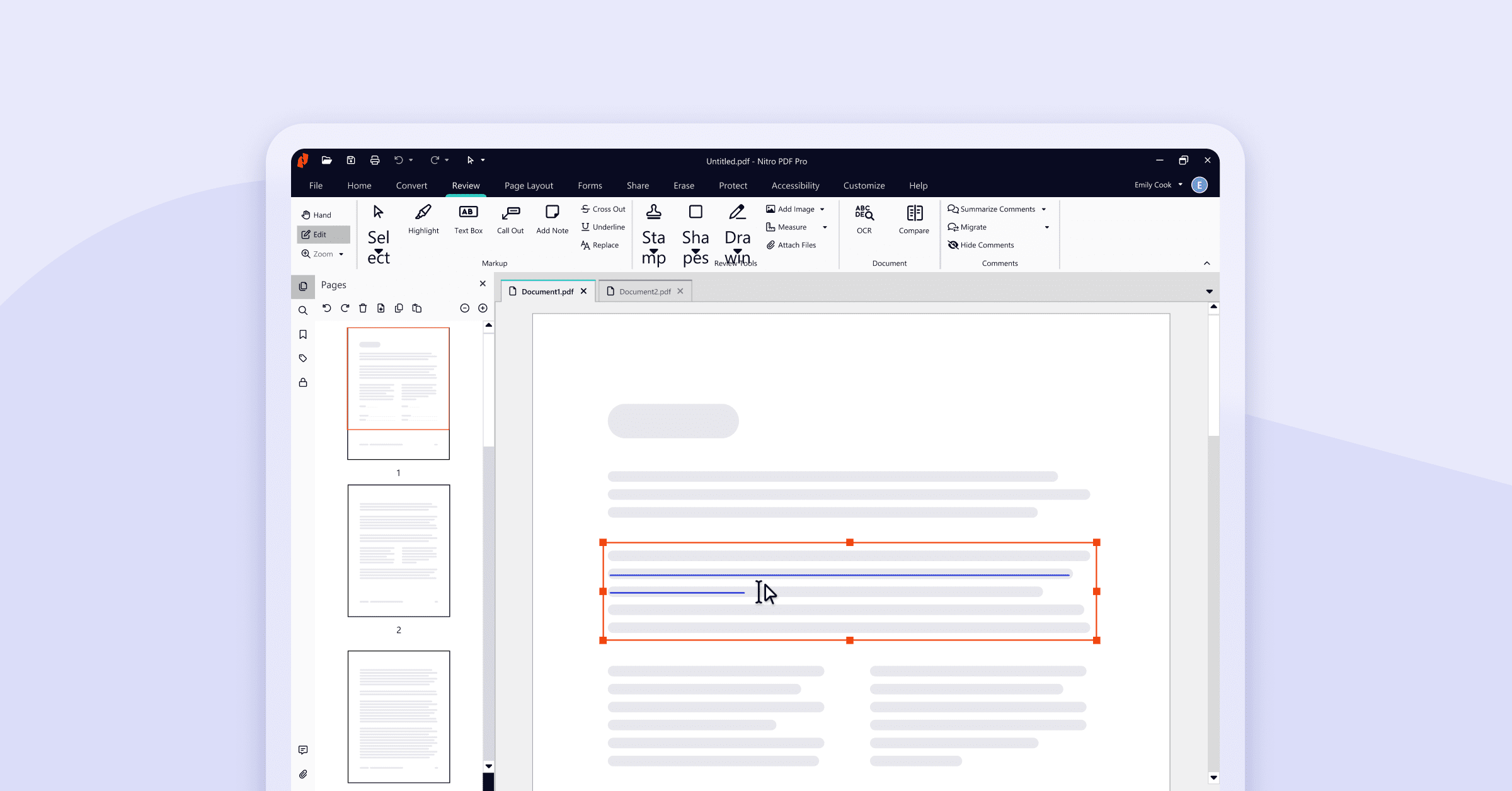
- Click "Edit" on the left-hand side of the ribbon menu
- Double-click directly on the text you want to modify
- Highlight the selected text to access formatting options (font, size, color, case)
- Make your text changes directly in the document
- Click "Finish" to save your edits
Nitro’s editing functionality also supports text redaction, whiteout, stamping, and complete text replacement for sensitive or outdated information.
Understanding the difference between writing and typing on a PDF
Writing on a PDF usually refers to document modifications like adding text, highlighting, or creating annotations, while typing in a PDF specifically means filling out form fields or replacing existing text using your keyboard.
Typing on a PDF is useful for:
- Filling out PDF forms without printing
- Adding information to scanned documents or photocopies
- Completing electronic contracts and applications
- Inserting quick notes or comments
The Type Text tool in Nitro PDF allows you to add typed content without accessing the original source files, making it ideal for documents you've received from others or legacy files where the original editable version no longer exists.
No matter what you need to do, working on a PDF is easy, fast and intuitive with Nitro.
Limitations of free PDF editors for writing and typing on a PDF
Free PDF editors may allow basic text additions, but they often lack advanced features like formatting, annotation tools, and cross-platform support.
Common limitations of free PDF tools include:
- Automatic file deletion: Many free tools delete your processed files after 1 to 2 hours, risking data loss.
- Watermarks: Free services frequently add visible branding or watermarks, making documents appear less professional.
- Restricted features: Free tools often lack support for important functionality like hyperlinks, embedded images, or eSignatures.
- No usage analytics: Services that offer limited or no data on document activity and engagement make it hard to track workflows.
- Version control issues: Tools that are unable to restore previous versions or track changes can introduce critical errors.
- Integration gaps: Free tools typically cannot connect with enterprise systems, cloud storage, or workflow automation, which slows collaboration.
- Compliance concerns: Most free PDF editors lack SOC2, GDPR, or other security certifications, making them unsuitable for professional, legal, or regulated documents.
Why a paid PDF editor is worth the investment
Professional PDF editors streamline document workflows, ensure compliance, and eliminate productivity bottlenecks caused by limited functionality.
Key advantages of professional PDF software include:
- Complete editing capabilities: Write, type, edit, redact, and annotate without restrictions.
- Security and compliance: SOC2 compliance and enterprise-grade security measures.
- Customization options: Add custom logos, page numbers, dynamic bookmarks, embedded hyperlinks, attachments, and timestamps.
- System integration: Connect with existing digital processes, cloud storage, and business applications.
- Reliable storage: Permanent file access without automatic deletion or file size limits.
- Professional output: Clean, watermark-free documents suitable for client delivery and legal use.
- Version control: Track changes, restore previous versions, and maintain document history.
For professionals who need to edit PDFs regularly, especially those in legal, healthcare, real estate, finance, or administrative roles, investing in a complete PDF editor provides full-featured text editing, annotation, form filling, and file management with reliable formatting, security, and support.
Upgrade to full-featured PDF editing today
Sign up for Nitro PDF Pro’s free 14-day trial and start writing, editing, and annotating PDFs across Windows, Mac, and mobile devices without feature restrictions or security concerns.